


Competitor Rate & Terms Tracker
Capital is a commodity; the terms dictate the winner. Operating a lending platform, debt fund, or acquisition desk without precise, systematic knowledge of competing term sheets guarantees lost deal flow and mispriced risk. The Competitor Rate & Terms Tracker provides capital allocators with a highly structured database to map the exact parameters offered by rival institutions, allowing for immediate tactical adjustments to maintain a competitive advantage in volatile capital markets.
Rate and Leverage Benchmarking
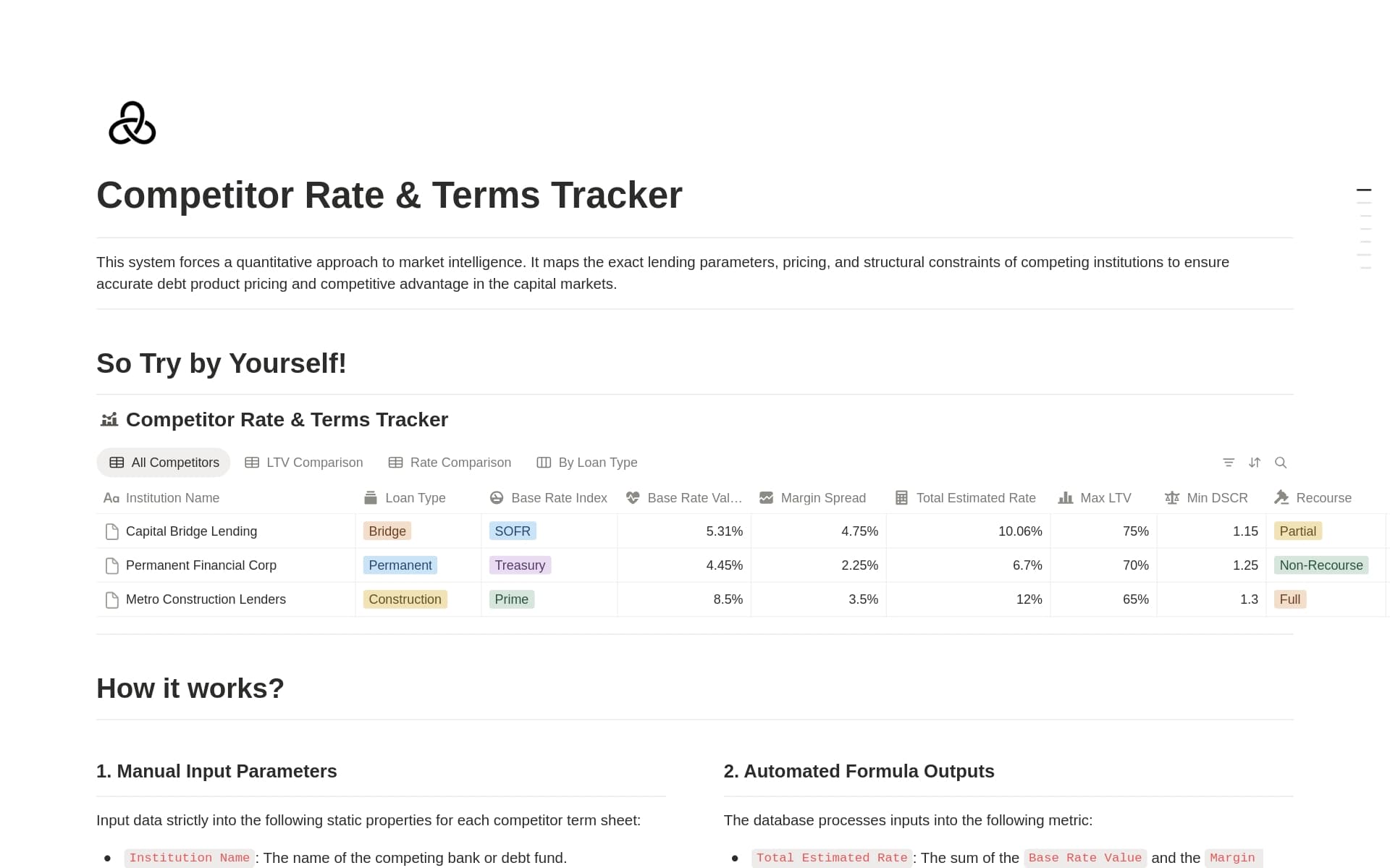
Relying on anecdotal broker feedback is entirely insufficient for pricing debt products. This database forces a strict quantitative approach to market intelligence. Users log verified competitor data, including base index rates (SOFR, Prime), minimum margin spreads, and required origination points. Beyond simple pricing, the system tracks absolute structural leverage limits. By documenting the maximum Loan-to-Value (LTV) and Loan-to-Cost (LTC) thresholds competing funds are willing to underwrite, operators can instantly identify if their own credit box is too restrictive or if competitors are taking on excessive risk to win volume.
Structural Covenant Analysis
The true, restrictive cost of capital is often hidden deep within the covenants. A competitor may offer a lower headline interest rate but require draconian structural terms. The Covenant Analysis module systematically tracks these secondary parameters. Users log competitor requirements for personal recourse, exact prepayment penalty structures (e.g., yield maintenance vs. step-down), cash management lockbox requirements, and minimum Debt Service Coverage Ratios (DSCR). Understanding these nuances allows originators to counter competitor term sheets by highlighting flexibility in structure rather than simply racing to the bottom on interest rates.
Win/Loss Deal Analytics
Market intelligence is only useful if it directly drives operational strategy. The system integrates a ruthless Win/Loss tracking framework. When a deal is lost to a competitor, originators must log the specific reason in the database: Was it lost on rate? Leverage? Speed of execution? Non-recourse availability? By aggregating this data over multiple quarters, management can definitively pinpoint the exact product gaps causing lost revenue. If the data shows 80% of lost multifamily deals went to a specific debt fund offering 75% LTV, management has the empirical justification required to adjust internal underwriting guidelines and immediately recapture that market share.